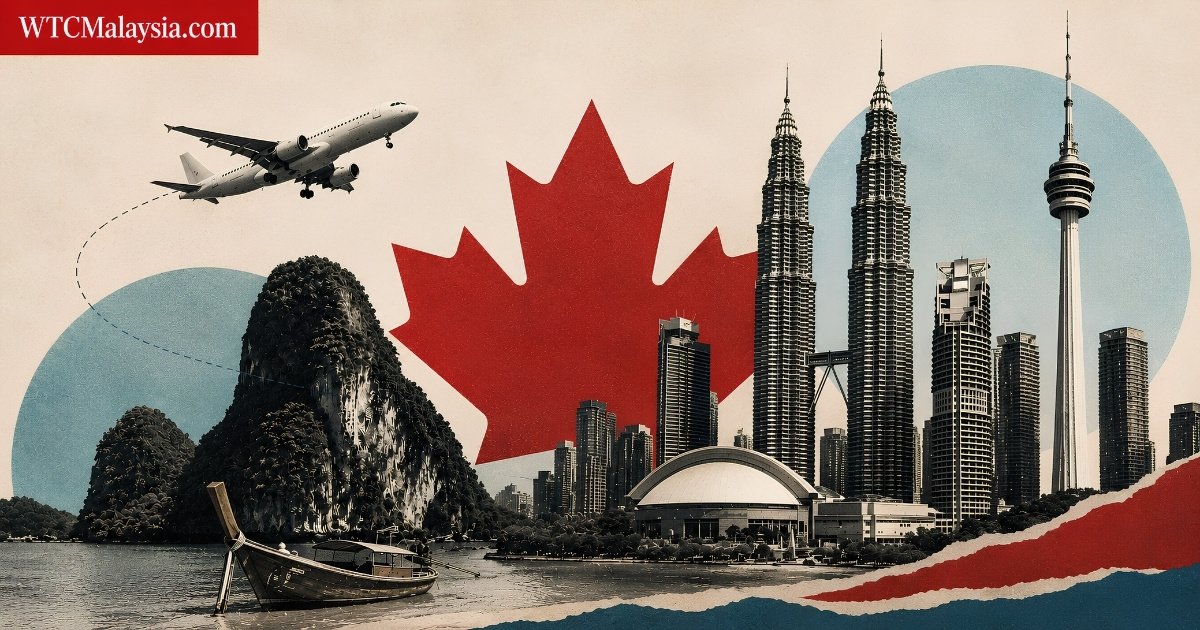
Malaysia and Canada are not natural tourism neighbours. They sit on opposite sides of the Pacific, separated by long flights, costly connections and time zones that make even a well-planned journey feel substantial. Yet that distance is also what makes the relationship interesting. Canada is not a mass tourism market for Malaysia. It is a high-value, underdeveloped market. And in 2026, it is becoming more strategically relevant.
The old tourism map is shifting. Canadians who once treated the United States as the easy default for holidays, shopping trips, family travel and winter escapes are now looking more carefully at alternatives. Political tensions, tariffs, a weaker Canadian dollar and changing consumer sentiment have reduced the appeal of cross-border travel. Some of that spending is staying inside Canada. Some is moving to Europe, the Caribbean and Mexico. But a portion is also available to longer-haul destinations that can offer safety, value and a clear reason to travel further.
Malaysia should pay attention. It will not capture Canadian travellers automatically. The route is too long, the market too competitive and the traveller too cost-conscious. But the opportunity is real. Canada is a wealthy outbound market, and Malaysia has a product that fits several Canadian segments: winter escape travellers, Muslim families, South Asian and Southeast Asian diaspora communities, students and parents, retirees, nature travellers, divers, food tourists and visitors looking for an English-friendly Asian destination that feels culturally comfortable.
Malaysia’s tourism industry enters this period from a strong position. Visitor numbers have recovered sharply, and Visit Malaysia 2026 gives the country a national platform to reposition itself. But the Canadian market requires a different strategy from nearby Asian markets. Canadians are not choosing Malaysia because it is convenient. They must be persuaded that it is worth the long journey.
The most important barrier is not only price. It is friction. A Canadian traveller considering Malaysia has to think about flight connections, transit reliability, total journey time, travel insurance, exchange rates and the risk of disruption. There is no simple weekend version of a Canada–Malaysia holiday. This means Malaysia must sell certainty as much as beauty.
The intern’s draft correctly identifies energy and aviation costs as part of the problem. Long-haul tourism is highly exposed to fuel prices and airspace disruption. When global energy markets tighten, the impact is felt first in aviation and transport. A family from Toronto, Vancouver, Calgary or Montreal may never read oil-market reports, but they will notice the effect when ticket prices rise, connection options narrow or airlines adjust schedules. The further the destination, the more vulnerable it becomes to this kind of cost pressure.
For Malaysia, this creates a strategic challenge. The country has traditionally marketed itself internationally as affordable, diverse and welcoming. That remains true. But for Canadian travellers, affordability inside Malaysia is not enough if the cost of getting there becomes too high. A hotel in Langkawi may offer good value, but that value matters less if the airfare consumes too much of the household budget before the journey begins.
This is why the Canadian market cannot be approached with a generic campaign. Malaysia should not simply advertise beaches, food and culture. It should build Canada-specific packages that reduce uncertainty. Canadians need to see the total cost clearly: flight, hotel, transfers, domestic travel, travel insurance options and flexible rebooking terms. In a period of economic caution, transparent pricing becomes a form of reassurance.
There is also a two-way opportunity that the intern’s original framing did not fully capture. Canada has recently changed its visa rules for eligible Malaysian travellers. Malaysians who have held a Canadian temporary resident visa in the past ten years, or who currently hold a valid United States non-immigrant visa, may now apply for an electronic travel authorization when flying to Canada instead of going through the full visitor visa process. This is not a full visa waiver for every Malaysian. But it is a significant facilitation measure for a valuable segment of travellers who have already been screened by Canada or the United States.
That change matters beyond tourism. Easier mobility supports education, family visits, business travel, conferences, investment exploration and people-to-people ties. Canada itself has framed the change as part of its Indo-Pacific engagement. Malaysia should treat it the same way. Tourism should not be viewed only as leisure. It is part of the human infrastructure of bilateral relations.
The Malaysian side should respond by making the new Canadian eTA eligibility widely understood. Travel agencies, universities, business chambers, airlines and student-recruitment networks should explain clearly who qualifies and who does not. The worst outcome would be public confusion: Malaysians assuming Canada is now visa-free for everyone, or eligible travellers failing to realise that travel has become easier for them.
For Canada, the policy opening is also clear. Malaysian travellers are not only tourists. They include parents visiting students, businesspeople attending meetings, families visiting relatives, professionals attending conferences and travellers combining Canada with the United States. The eTA change can help Canada attract precisely the kind of higher-intent visitors who are more likely to spend, connect and return.
For Malaysia, Canadian inbound tourism should be treated as a quality market. In 2024, Canada was not among Malaysia’s top arrival markets, but it ranked inside the top twenty for visitor receipts. That suggests a useful pattern: Canadian visitors may be fewer in number, but the market has spending value. A Canadian traveller is more likely to stay longer than a short-haul visitor and may combine multiple destinations: Kuala Lumpur, Penang, Langkawi, Sabah, Sarawak or medical and wellness travel.
Malaysia should therefore stop seeing Canada as a small distant market and start seeing it as a specialised long-haul market. The correct question is not: how do we bring millions of Canadians? The better question is: how do we attract the right Canadians, keep them longer, and make their spending reach local communities?
The strongest Canadian segments are clear. Winter travellers want warmth, beaches and comfort during Canada’s coldest months. Muslim Canadians may value Malaysia’s halal ecosystem, mosques, family-friendly hotels and cultural familiarity. South Asian and Southeast Asian diaspora travellers may be attracted by food, regional connectivity and a softer landing into Asia. Adventure travellers may be drawn to Sabah, Sarawak, diving, rainforest and wildlife. Retirees and long-stay visitors may be interested in healthcare, wellness, affordability and safety.
Malaysia should design packages around these groups, not around a generic “Canadian tourist”. A Toronto Muslim family, a Vancouver retiree, a Montreal adventure traveller and a Calgary business visitor do not need the same message. But each could find a reason to choose Malaysia if the offer is built properly.
Air connectivity remains the hardest issue. Direct flights may not be commercially realistic in the short term, but Malaysia does not need to wait for direct flights to act. It can work with airlines and travel partners to improve one-stop itineraries through reliable hubs such as Tokyo, Seoul, Taipei, Hong Kong, Singapore, Istanbul and selected Gulf routes where operations remain stable. The policy target should be simple: make Malaysia easier to package from Canada on a single ticket, with protected connections and clear travel support.
This is also where Malaysia Airlines, Tourism Malaysia, airport authorities and private travel agencies should coordinate more seriously. The Canadian market cannot be won by advertising alone. It requires product building. A traveller should be able to buy a clear fourteen-day Malaysia package from Toronto or Vancouver that includes flights, transfers, domestic connections and a realistic itinerary. The package should not feel improvised.
Malaysia’s domestic tourism operators also need protection from cost pressure. Energy and transport costs affect tour buses, airport transfers, food logistics, laundry, hotel operations and domestic travel. If Malaysia wants to attract long-haul visitors, it must protect the value they experience after arrival. A Canadian who has already paid heavily for flights will be less tolerant of unclear pricing, weak service or unexpected add-on costs inside the country.
This does not require blanket subsidies. It requires targeted support for the tourism supply chain. Licensed inbound operators, tour-bus companies and SMEs serving long-haul packages should be given temporary tax relief, training support or targeted incentives when global fuel shocks threaten package competitiveness. The aim should not be to hide costs forever. It should be to prevent short-term shocks from damaging Malaysia’s long-term reputation as a value-rich destination.
Malaysia should also communicate safety intelligently. Canada’s travel advice allows normal travel across most of Malaysia, with additional caution for specific areas in eastern Sabah. Malaysia should not ignore this. It should clarify it. Good tourism communication separates localised risk from national perception. If a warning about one area is misunderstood as a warning about the whole country, Malaysia loses unfairly.
A standing travel-confidence platform would help. Tourism Malaysia should create a Canada-facing digital page that explains entry requirements, route options, recommended itineraries, safety information, halal and family travel facilities, medical travel options, and real-time updates during global disruptions. In uncertain times, reliable information becomes part of the product.
The policy advice is therefore straightforward. Malaysia should create a Canada–Malaysia Tourism and Mobility Corridor for 2026–2027. It should combine inbound Canadian tourism promotion with outbound Malaysian mobility to Canada under the new eTA rules. It should not be treated as a normal marketing campaign. It should be a targeted bilateral mobility strategy involving Tourism Malaysia, MOTAC, airlines, MATTA, the Malaysian High Commission in Ottawa, the Canadian High Commission in Kuala Lumpur, universities, chambers of commerce and selected state tourism boards.
The corridor should have five practical components. First, Canada-specific long-stay packages built around winter escape, halal travel, nature tourism, medical and wellness travel, and education-linked family visits. Second, airline and travel-agency partnerships that create easier one-stop Canada–Malaysia itineraries. Third, a public information campaign explaining Canada’s new eTA eligibility for Malaysians accurately. Fourth, tourism SME support to maintain service quality and value during periods of energy-cost pressure. Fifth, stronger use of diaspora, student and business networks to convert people-to-people ties into travel demand.
Malaysia should not expect Canada to become a top-five arrival market. That is not realistic. But Canada does not need to be a mass market to be valuable. It can be a higher-spending, longer-stay, strategically useful market that strengthens tourism, education, business travel and bilateral familiarity at the same time.
The real risk is not that Canadians reject Malaysia. It is that Malaysia never enters their imagination at the right moment. Canadian travel habits are being rewritten. Malaysia has a chance to become part of the new map. But it must reduce friction, sell certainty and speak directly to the travellers most likely to care.
In long-haul tourism, distance is not always the enemy. Uncertainty is. If Malaysia can make the journey feel clear, safe and worth it, Canada becomes less distant than it looks.