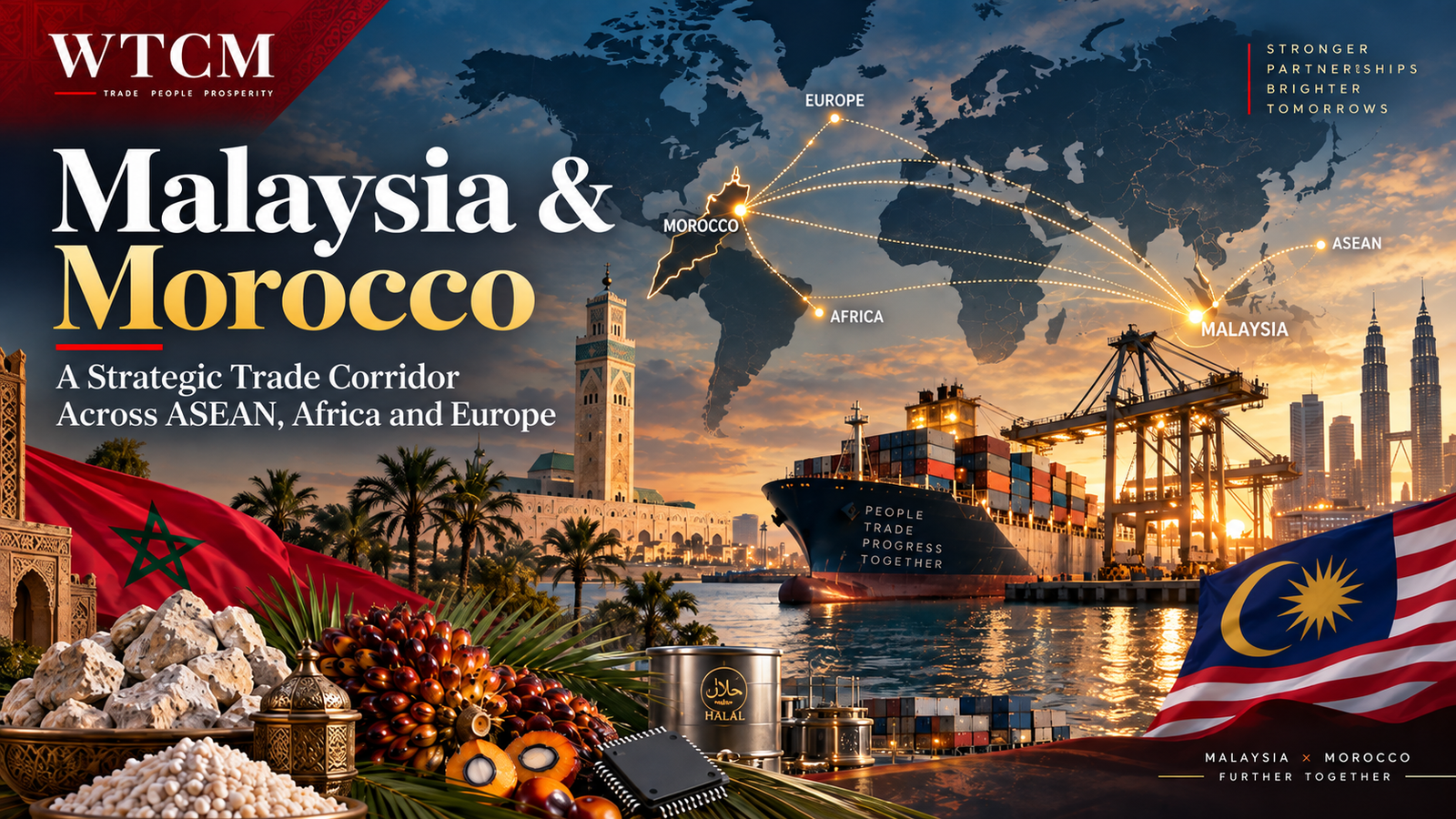
Trade between Malaysia and Morocco remains relatively small, but the relationship is becoming more relevant as both countries look for wider market access and more dependable commercial partners.
Malaysia brings established capabilities in manufacturing, electrical and electronic products, palm oil, rubber, halal industries and industrial processing. Morocco brings a strong logistics position between Africa and Europe, a major phosphate and fertiliser industry, and growing manufacturing capacity.
The relationship is still modest compared with Malaysia’s major trading partners, but its potential should not be judged only by current trade volume. The more useful question is whether both countries can use their regional positions to help companies reach wider markets.
Bilateral trade is still small, but the product mix is broadening
Malaysia’s exports to Morocco reached RM497.7 million in 2025, an increase of 3.8% from the previous year. Malaysia had also recorded strong export growth to Morocco in 2023, driven in part by palm oil and palm-oil-based agricultural products.
UN Comtrade-based data show that Malaysia’s main exports to Morocco include animal and vegetable oils, machinery, electrical and electronic equipment, inorganic chemicals and rubber products. Imports from Morocco include electrical equipment, fertilisers, aircraft-related products, apparel, aluminium, agricultural products, ores and seafood.
This shows that the relationship already extends beyond a narrow exchange of commodities. It includes manufactured products, industrial inputs, agriculture-related goods and machinery.
What is still missing is scale.
The policy question is therefore not whether Malaysia and Morocco trade with each other. They already do. The question is how that relationship can become commercially more useful to companies in both countries.
Morocco matters because of where it sits
For Malaysian companies, Morocco should not be viewed only as a domestic market.
Its location is part of its commercial value.
Tanger Med is connected to more than 180 ports in around 70 countries and serves a large number of African destinations through regular maritime links.
That gives Malaysian companies a possible route into markets beyond Morocco itself, including parts of North Africa, West Africa and Southern Europe.
This fits with Malaysia’s wider need to diversify trade beyond its traditional markets.
Malaysia has already recorded stronger exports to several African and emerging markets in recent years, including Morocco, Kenya, Nigeria, Tanzania and Algeria.
The opportunity is therefore larger than bilateral trade alone. Morocco can be considered as part of a broader regional market strategy.
Malaysia can play the same role for Moroccan companies in ASEAN
The same logic works in the opposite direction.
ASEAN has a population of more than 680 million people and a combined economy of roughly US$3.9 trillion.
Malaysia is deeply connected to ASEAN’s manufacturing, logistics and trade networks.
For Moroccan businesses, Malaysia can therefore offer more than access to the Malaysian market. It can also provide a route into Southeast Asia.
Morocco has strengths in phosphates and fertilisers, automotive manufacturing, agri-food, aerospace and industrial production. Malaysia has strengths in electronics, machinery, rubber products, palm oil, medical manufacturing, halal industries and Islamic finance.
The practical opportunity is to identify where these strengths can connect. That is more useful than simply setting a target for higher bilateral trade.
Agriculture and fertiliser cooperation deserves more attention
Agriculture is one of the clearest areas where both countries have complementary interests.
Morocco is one of the world’s most important phosphate and fertiliser producers.
Malaysia remains a major agricultural producer and depends on imported inputs for parts of its agricultural sector.
Fertilisers are already among Malaysia’s notable imports from Morocco.
That creates room for more structured cooperation in fertiliser supply, agricultural technology, food processing and related supply chains.
For Malaysia, this could also be relevant to longer-term food and agricultural security. For Morocco, Malaysia offers access to agricultural and food-processing networks in Southeast Asia.
Halal trade could become more practical
Malaysia and Morocco are both members of the Organisation of Islamic Cooperation.
Malaysia also has one of the more developed halal trade and certification ecosystems in the Muslim world.
That creates room for cooperation in food, ingredients, certification, traceability and consumer products.
However, halal cooperation should not be treated only as a certification issue.
There may be more value in looking at whether Malaysian and Moroccan companies can jointly develop products for African, European and Middle Eastern markets.
That would give the relationship a commercial purpose rather than leaving it at the level of institutional cooperation.
Islamic finance is another area that could be developed
Malaysia is one of the world’s more established Islamic finance centres.
Morocco has also been developing its participatory finance sector.
There are already institutional links between the two countries through wider Islamic finance platforms. Morocco hosted Islamic Financial Services Board meetings in Rabat, while Moroccan authorities have also participated in forums involving Bank Negara Malaysia.
This could eventually support trade and investment between the two countries.
Islamic finance could be used for joint ventures, infrastructure, halal industries and cross-border investment.
The value would be greater if trade and financing were considered together rather than as separate areas.
The absence of an FTA is a real constraint
Malaysia and Morocco do not currently have a bilateral free trade agreement.
Morocco does not appear among Malaysia’s existing bilateral FTA partners.
That means companies cannot rely on the same preferential tariff treatment available under some of Malaysia’s other trade relationships.
For certain products, this can affect price competitiveness and margins.
But a full FTA should not automatically be treated as the first answer.
Both sides should first identify where tariffs, standards, customs procedures or other barriers are actually limiting trade.
In some sectors, a targeted preferential arrangement, mutual recognition or sector-specific facilitation may be more practical than starting with a broad agreement.
Logistics remains one of the main commercial problems
Distance remains a structural issue.
Shipping between Malaysia and Morocco takes longer and costs more than trade within Asia.
This becomes more important during periods of congestion, shipping disruption or geopolitical instability.
That means companies need to think about more than export demand. They also need to consider route reliability, warehousing, inventory, distribution partners and local logistics costs.
Tanger Med gives Morocco a strong logistics advantage, but Malaysian companies still need workable commercial routes into that network.
This is where cooperation between logistics companies, distributors and port-linked businesses may matter more than high-level announcements alone.
Market entry should rely more on strategic partnerships
One of the main lessons from this relationship is that expansion into a new market should not be treated only as a sales exercise.
Companies entering Morocco need to understand the country’s regulatory environment, commercial networks and wider regional role.
The same applies to Moroccan companies entering Malaysia.
For Malaysian firms, the right Moroccan partner may provide access not only to domestic buyers but also to networks in Africa and Europe.
For Moroccan firms, the right Malaysian partner may provide access to ASEAN.
That makes partner selection more important than simply finding an importer.
Government cooperation should focus on practical barriers
There is already a diplomatic base for stronger cooperation.
In February 2026, the ASEAN Committee in Rabat met Morocco’s Ministry of Industry and Trade to discuss stronger trade cooperation, market access and business linkages.
The next stage should focus more on specific commercial problems.
These could include tariffs, standards, halal recognition, customs procedures, logistics, market access and financing.
Progress should be measured by whether companies can enter the market more easily, not by the number of meetings held.
The bigger opportunity is regional
Malaysia and Morocco are far apart geographically, but both sit in useful regional positions.
Malaysia is part of one of the world’s most important manufacturing and consumer regions.
Morocco sits between Africa and Europe and has built logistics and industrial infrastructure that serves markets beyond its own borders.
The larger opportunity is therefore not the current bilateral trade figure.
It is whether both countries can use each other as entry points into wider markets.
For Malaysia, Morocco can support access into parts of Africa and Europe.
For Morocco, Malaysia can support access into ASEAN.
If that relationship becomes more structured, there is room for cooperation in manufacturing, agriculture, halal industries, finance and logistics.
The next phase should be built around practical commercial access, reliable local partners and sectors where both countries have something useful to offer each other.