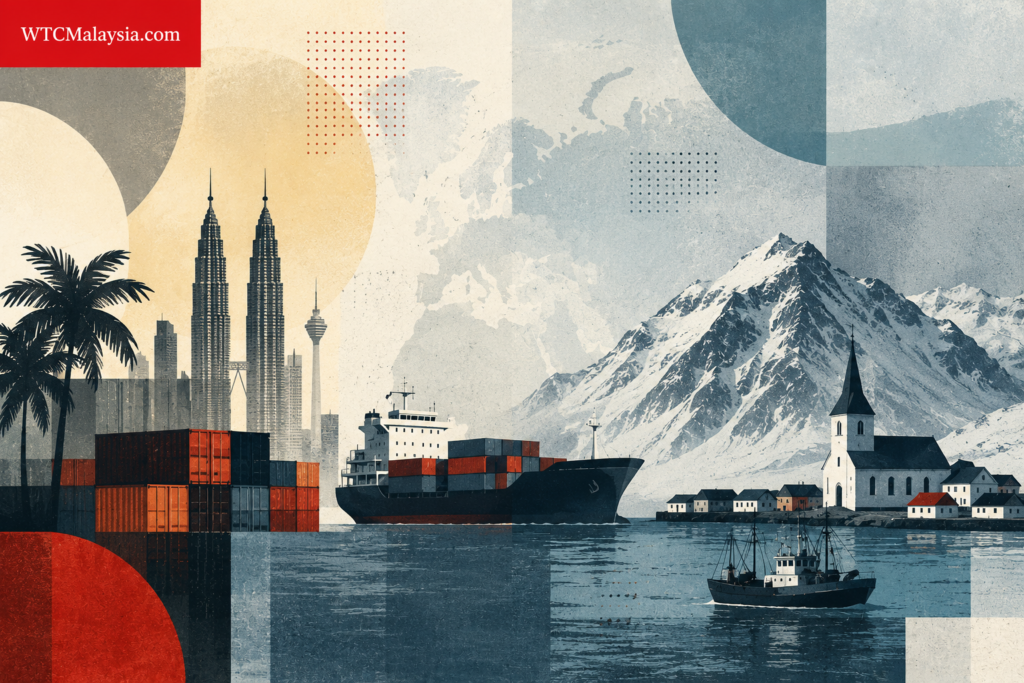
Malaysia and Iceland are unlikely to become major trading partners anytime soon. The distance between Southeast Asia and the North Atlantic alone makes that difficult. Yet the relationship between the two countries offers a useful reminder that trade is not always driven by size. Sometimes it is driven by difference.
Malaysia and Iceland sit at opposite ends of both geography and economic structure. Malaysia is a manufacturing and export hub deeply integrated into Asian supply chains, particularly in electronics and industrial production. Iceland, meanwhile, has built its economy around fisheries, renewable energy and highly specialized resource management. One exports semiconductors and machinery. The other exports seafood and sustainability expertise.
At first glance, there appears to be little connecting the two economies. Bilateral trade remains modest and has shown little dramatic expansion over the past decade. But unlike larger trading relationships that often fluctuate with political tensions or industrial competition, the Malaysia–Iceland relationship has remained unusually stable precisely because the two countries do not compete directly with one another.
Malaysia’s exports to Iceland consist mainly of manufactured goods, including electrical equipment, machinery and rubber-based products. Iceland’s exports to Malaysia are dominated by seafood and marine products, reflecting the country’s long-standing dependence on fisheries. The relationship is less about scale than about economic complementarity.
That complementarity may become more relevant in the years ahead. Iceland has increasingly positioned itself as a global example of renewable energy integration. According to official Icelandic energy authorities, nearly all of the country’s electricity production comes from renewable sources, particularly geothermal and hydropower. Few countries have managed such a transition at national scale.
Malaysia faces a very different challenge. Its economic strength lies in industrial growth, export manufacturing and technological integration. As global supply chains continue to reorganize, Malaysia is attempting to strengthen its role in advanced manufacturing while balancing growing pressure for sustainability and energy transition.
This creates a narrow but potentially meaningful space for cooperation. Iceland’s expertise in renewable systems and sustainable resource management may become increasingly valuable to countries seeking practical models for long-term energy resilience. Malaysia, meanwhile, offers industrial capacity, manufacturing ecosystems and access to wider ASEAN markets.
None of this is likely to transform the relationship into a major economic corridor. Geography still matters. Iceland’s domestic market remains small, transport costs remain high and the priorities of both economies are fundamentally different. But in a world where governments are increasingly seeking to diversify supply chains and reduce strategic overdependence, even smaller relationships can acquire greater relevance.
The more realistic future for Malaysia–Iceland trade lies not in dramatic expansion, but in selective cooperation. Renewable energy, sustainable industrial systems, marine technologies and green manufacturing are all areas where targeted partnerships may gradually emerge. Universities, technical agencies and niche industries may ultimately play a larger role than large-scale trade agreements.
For policymakers, the lesson is straightforward. Not every successful trade relationship needs to become massive. Some relationships derive value from stability, specialization and strategic flexibility. Malaysia and Iceland may never trade at enormous scale, but their economic differences could prove more useful than their limitations.