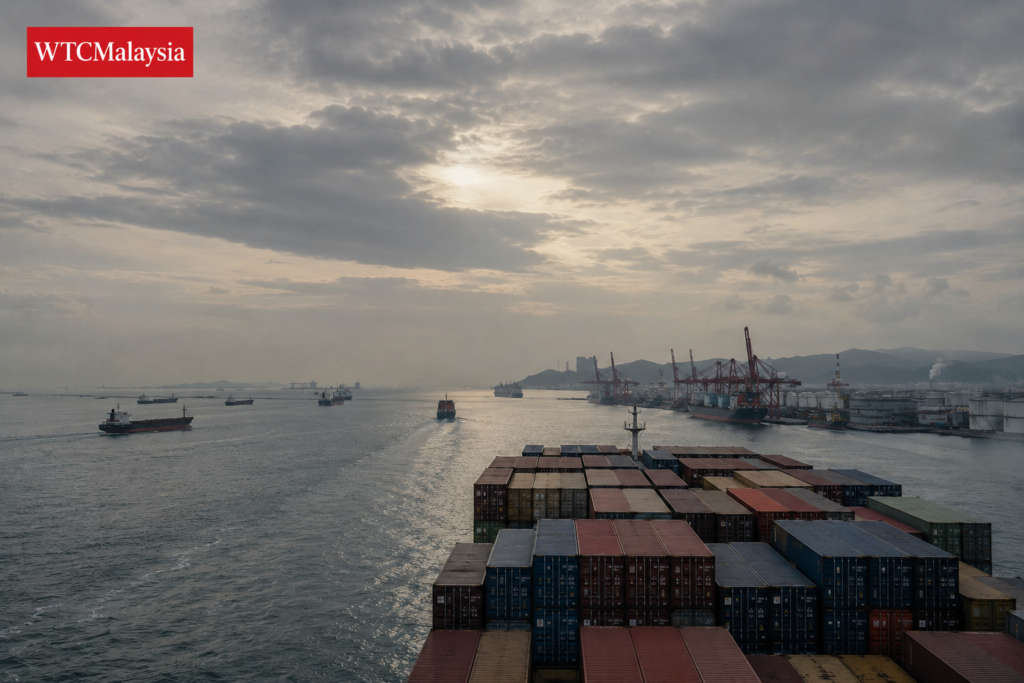
Global trade often appears to be governed by prices, contracts and shipping schedules. In reality, it is also governed by geography. A narrow sea lane, a regional conflict or a sudden rise in fuel costs can quietly change the economics of trade far beyond the country where the crisis begins.
The Middle East is the clearest example of this. It is not only a region of political tension; it is one of the main arteries of the global energy system. The Strait of Hormuz remains especially important. According to the U.S. Energy Information Administration, oil flows through the strait averaged about 20 million barrels per day in 2024, equal to roughly 20% of global petroleum liquids consumption. It is also a major route for liquefied natural gas.
This is why tensions involving Iran, Israel and the United States matter to countries far from the Gulf. Even before a full disruption occurs, markets react to the possibility of disruption. Shipping firms adjust risk calculations. Insurers raise premiums. Energy traders price in uncertainty. Importers and exporters begin to face a problem that is difficult to manage: not only higher costs, but unstable costs.
The first impact is felt in transport. Maritime trade remains the backbone of global commerce, and UNCTAD notes that shipping carries more than 80% of world trade. Its 2025 review warned that maritime trade was under pressure from rising costs, geopolitical tensions and reconfigured routes.
When vessels avoid risky areas, they do not simply disappear from the system. They travel farther, burn more fuel and arrive later. A longer route may protect a ship from danger, but it raises the cost of almost everything on board. That cost then moves through the supply chain: from shipping line to importer, from importer to distributor, and finally to businesses and consumers.
The second impact is industrial. Energy is not only used to move goods; it is used to make them. Fertilizer, chemicals, plastics, processed food, metals and many manufactured goods are sensitive to fuel and gas prices. The World Bank has warned that fertilizer prices remain a pressure point in food markets, with urea prices surging sharply between February and March 2026 amid conflict-related disruption and tighter market conditions.
This link is often underestimated. A disruption in an energy route can raise fertilizer costs. Higher fertilizer costs can raise farming costs. Higher farming costs can raise food prices. A conflict that begins as a security issue can therefore become a household cost issue in countries that are not militarily involved at all.
For Malaysia, the lesson is direct. Malaysia is an open trading economy with export strengths in electronics, palm oil products, chemicals, machinery, halal products and manufactured goods. Its competitiveness depends not only on production capability, but also on predictable logistics and reasonable freight costs. When fuel prices rise or shipping routes become unstable, Malaysian exporters face weaker pricing certainty and importers face higher landed costs.
Yet the same instability also creates strategic opportunity. As companies reassess exposure to distant conflicts, fragile routes and concentrated production bases, Southeast Asia becomes more relevant. Malaysia’s ports, manufacturing base, English-speaking business environment and regional location give it a useful position for firms seeking a stable Asian platform.
The policy response should therefore be practical, not rhetorical. Malaysia should strengthen logistics resilience, deepen regional trade partnerships and continue positioning itself as a reliable base for manufacturing, food processing, halal production and regional distribution. It should also treat energy and supply-chain risk as part of economic policy, not only as foreign policy.
For Malaysia’s partners, the recommendation is equally clear. Diversifying trade and production links with stable economies in Southeast Asia is no longer just a commercial option. It is a hedge against geopolitical uncertainty.
The broader conclusion is simple: modern trade is not disrupted only when factories close or demand falls. It is disrupted when the routes, fuel and confidence that support trade become unstable. Countries that understand this connection early will be better prepared to protect prices, secure supply chains and attract the next wave of investment.